
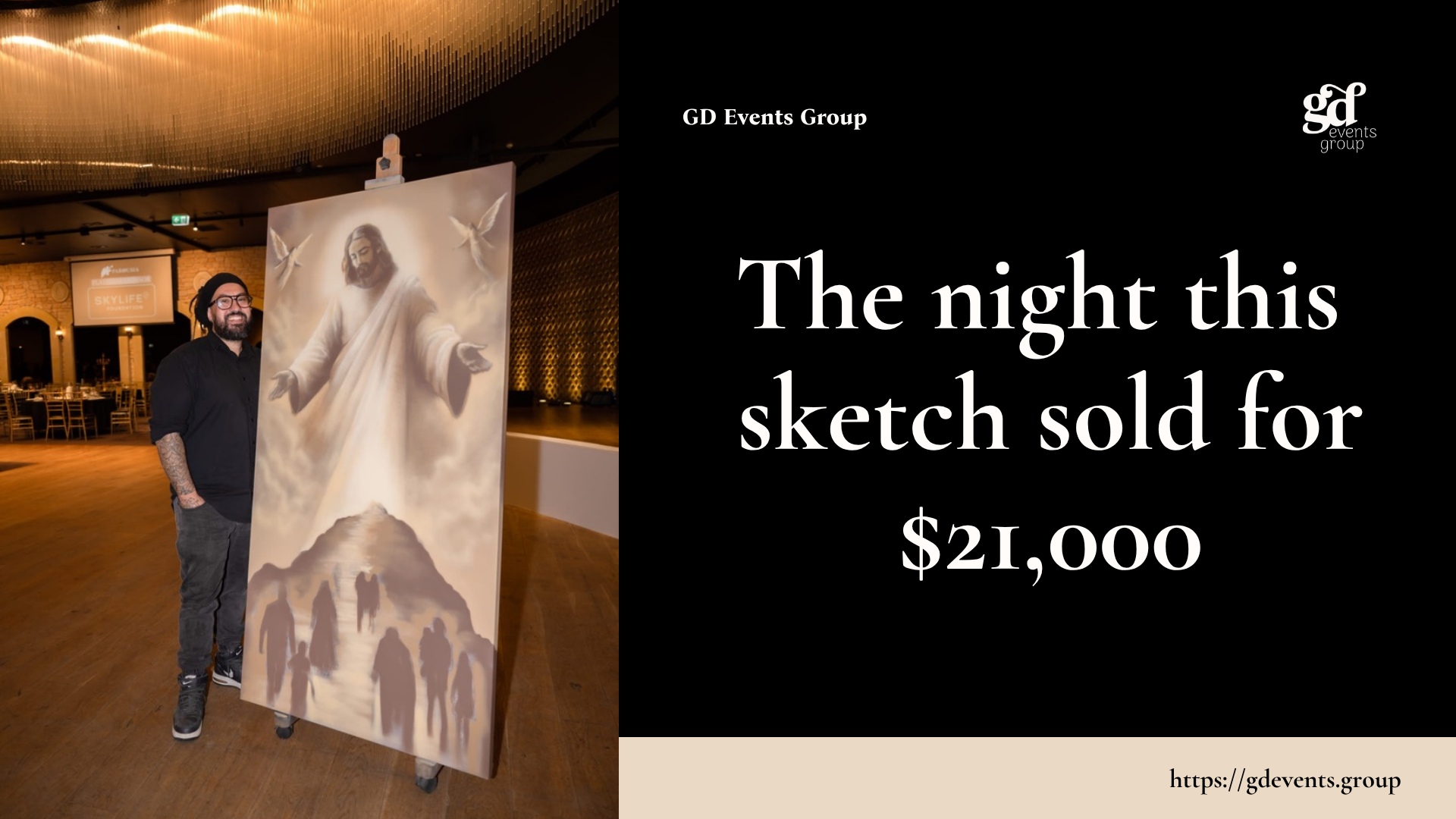
Charity Gala Fundraising Ideas — How a Live Sketch Raised $21,000
Charity gala fundraising ideas that work: how one live sketch raised $21,000 at a Sydney gala, and how sensory strategy makes guests give with conviction.
Last week at a client's gala, a single sketch drawn live during dinner sold at auction for $21,000. More than double what anyone expected. It was the moment of the night, and it looked effortless.
It wasn't. It was designed. And if you run fundraising events for a charity, a foundation or a cause, the thinking behind it will make you more money than any venue upgrade ever will.
The item was built around the mission, not the menu
Months before the night, we sat down and designed the concept together. Not "let's have an artist" but a piece that captured the purpose of the evening, the organisation's tagline and the story they'd spent 21 years building. By the time it went to auction, guests weren't bidding on a drawing. They were bidding on what it meant.
It unfolded across the whole night
The artist drew from the first course to the last. Guests watched it come to life all evening... walked past it, talked about it, photographed it. When it finally went under the hammer it wasn't an item on a list. It was the night itself, and everyone in the room had a relationship with it.
The ask was scripted, not improvised
The biggest moment wasn't the auction. It was the host's speech before it. We worked on it together until the message was clear and the cause was even clearer, so when the ask came, it was easy. Nobody gives generously because they were pressured. They give because they feel something and suddenly the amount makes sense.
People give with their senses, not their logic
That's the whole lesson, and it's the foundation GD is built on. We design every fundraising event to a sensory strategy... what the room looks like, sounds like, tastes like and feels like at each point of the night, because guests decide emotionally first and justify it logically second. A room that feels moved gives with conviction. A room that feels processed gives the minimum. Every choice... the flow, the timing, the words, the light... either builds that feeling or leaks it.
This is the work I do underneath fundraising events. Not just the logistics, but the senses, the story and every single piece of the puzzle pointing at the outcome, so your guests don't just enjoy the night... they move with conviction.
If your organisation has a gala, a dinner or an appeal coming up, send me a message at info@gdevents.com.au or through the contact page. I'd love to help you build a night that raises what your cause deserves.

How to Plan an End-of-Year Party Your Team Actually Wants
Most work Christmas parties are booked in a rush and forgotten by February. The best ones are designed — and there's real psychology behind why they matter.
Every December, the same scene plays out in venues across Sydney: a room booked in a hurry sometime in November, a set menu, a speech, and a team that files out by nine o'clock wondering why they came. Then every January, leadership wonders quietly whether the party was worth it.
Here's the thing — it was worth it. It just wasn't designed to be.
Why the end-of-year party matters more than you think
Psychologists call it the peak-end rule: people don't remember an experience evenly. They remember its most intense moment — the peak — and how it ended. Everything else fades.
A team's year works exactly the same way. Nobody remembers every week of a year. They remember the highs, and they remember how it finished. The end-of-year celebration isn't a nice-to-have sitting outside the real work — it is the ending, and it quietly colours how the entire year gets remembered. End the year flat, and even a good year feels flat in hindsight. End it with genuine warmth and celebration, and even a hard year lands as one that meant something — and a team that feels their year meant something starts the next one differently.
Why November bookings disappoint
There's a second piece of psychology at work: we consistently underestimate how long good things take to arrange — planners call it the planning fallacy. By November, the venues worth having are gone, the details become compromises, and the party becomes something that happened to everyone rather than for them. The parties people rave about in January were shaped in August and September — not because their organisers were early, but because they understood what the night was actually for.
What a party your team actually wants looks like
After years of designing end-of-year celebrations, the pattern is clear. The parties people love aren't the most expensive — they're the ones designed around a feeling rather than a format. A genuine thank you rather than an obligation. A room that feels considered from the moment you walk in — the light, the food, the flow of the night — rather than a function-centre package. Moments that belong to this team and this year, not a template. And an ending on a high note, because the ending is what everyone carries out the door.
Start with one question — not "where should we book?" but "how do we want the team to feel walking out?" Every good decision flows from that answer.
The timing truth
If you're reading this in August or September, you're right on time. If your end-of-year celebration matters this year — and after the year your team has put in, it should — this is when the good ones take shape. We'd love to hear what you're imagining: info@gdevents.com.au.
GD Events Group designs corporate events, celebrations and experiences across Sydney — built on one belief: an experience isn't finished until people stop talking about it.